

Initiatives to Address Climate Change
Under our Corporate Philosophy of “Creation, Contribution, and Cooperation,” the Tadano Group strives to contribute to the preservation of the environment and the realization of a sustainable society through maximizing value to our stakeholders and engaging in sustainable business activities. We aim to pursue further excellence for the world and the future. The Tadano Group has redefined its approaches to sustainability issues in general and from the perspectives of “Governance,” “Strategy,” “Risk Management,” and “Metrics and Targets,” and has been strengthening its efforts. By carrying out Tadano Green Solutions, we will contribute to the improvement of the global environment and the achievement of a decarbonized society.

Governance
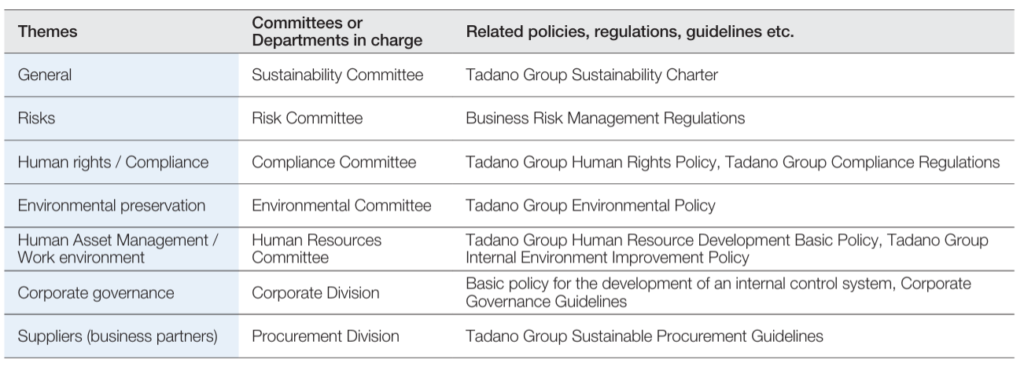
We have established the Sustainability Committee, chaired by the President and comprising all Chiefs of Headquarters as members, to define the key issues of sustainability in management, and to manage policies, goals and progress. The Committee members sequentially report and discuss sustainability issues and other important matters concerning their divisions at regular Monthly Management Briefings, Management Meetings, Board of Directors Meetings, and other meetings.
We also have the Sustainability Promotion Group within the General Affairs Department as a dedicated team to support the work of each division for sustainability. In addition, specialized committees are organized under the Sustainability Committee to work on company-wide themes, which include the Risk Committee, the Compliance Committee, the Environmental Committee and the Human Resources Committee. In 2021, we established the CO2/Energy Reduction Subcommittee and the Waste/Chemical Substances Reduction Subcommittee as organizations within the Environmental Committee. These subcommittees are studying specific actions to take, sharing information among different divisions, and working for continued improvements aimed at achieving our long-term targets.
Strategy
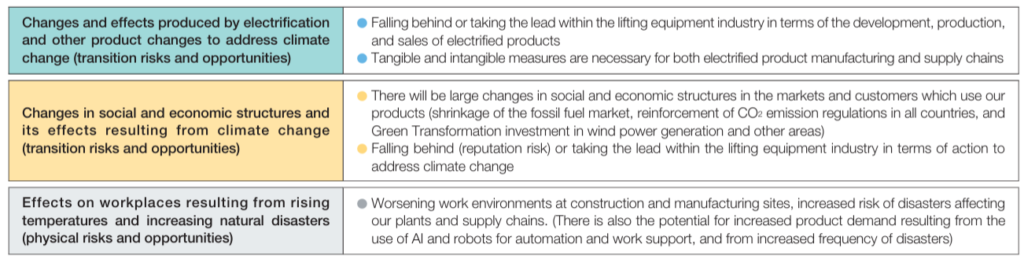
As a basic policy for the promotion of sustainability, we have established the Tadano Group Sustainability Charter comprising seven principles: “Respect for Human Rights,” “Fair and Honest Business Activities,” “Respect for Employees and Ensuring Job Satisfaction,” “Growing Together with Suppliers,” “Preservation of the Environment,” “Contribution to Society” and “Effective Communication.” We have been developing related policies, regulations, and guidelines to incorporate these principles into the annual policies and business plans of divisions and group companies as well as specific measures. We also established the Tadano Group Sustainable Procurement Guidelines in January 2024 to promote sustainability among suppliers (business partners). With respect to climate change, the CO2/Energy Reduction Subcommittee has studied the transition risks and opportunities resulting from the so-called 2℃ scenario, as well as the physical risks and opportunities resulting from the 4℃ scenario, and has produced the analysis shown below regarding risks and opportunities in the Tadano Group.
Risk Management
The business operations of the Tadano Group involve various risks, including business strategic risks, legal risks, product safety risks, information security risks, environmental risks, and natural disaster risks. For risk management, the Risk Committee periodically identifies and evaluates risks based on the Tadano Group Business Risk Management Regulations. The Committee designates departments responsible for addressing each risk and taking responsive measures to strengthen the Tadano Group’s risk management. The results of evaluations by the Risk Committee are reported to the Board of Directors Meeting twice a year.
Metrics and Targets
The Tadano Group endeavors to preserve and contribute to the global environment with its long-term environmental targets for 2030 of a 25% reduction in CO2 emissions from business activities, a 35% reduction in CO2 emissions from product use, and a 50% reduction in the volume of industrial waste from business activities (compared to the 2019 baseline).
Changes in CO2 emissions from the Tadano Group’s business activities (Scopes 1 and 2) are shown as below.
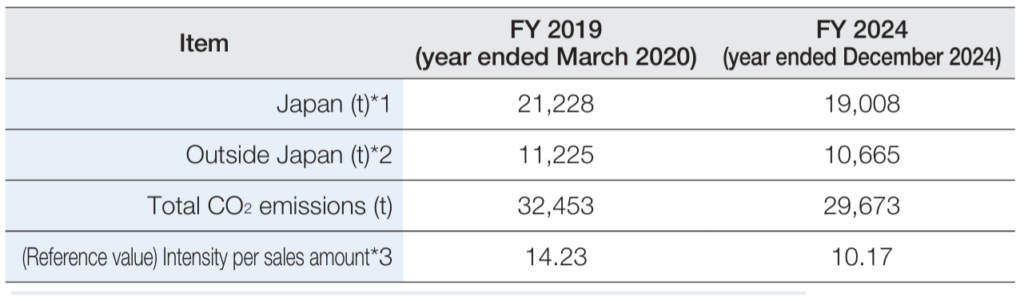
*1: Applicable to all business locations in Japan (including group companies and plants, etc.)
*2: Applicable to production locations outside Japan. The scope of calculation will be expanded to other group companies outside Japan in the future.
*3: Intensity with the Tadano Group sales amount as the denominator is indicated (CO2: ton/sales: 100 million yen).
*4 Figures for the base year FY 2019 and the subsequent years are recalculated every year to reflect changes in the scope of consolidation due to business combinations etc.
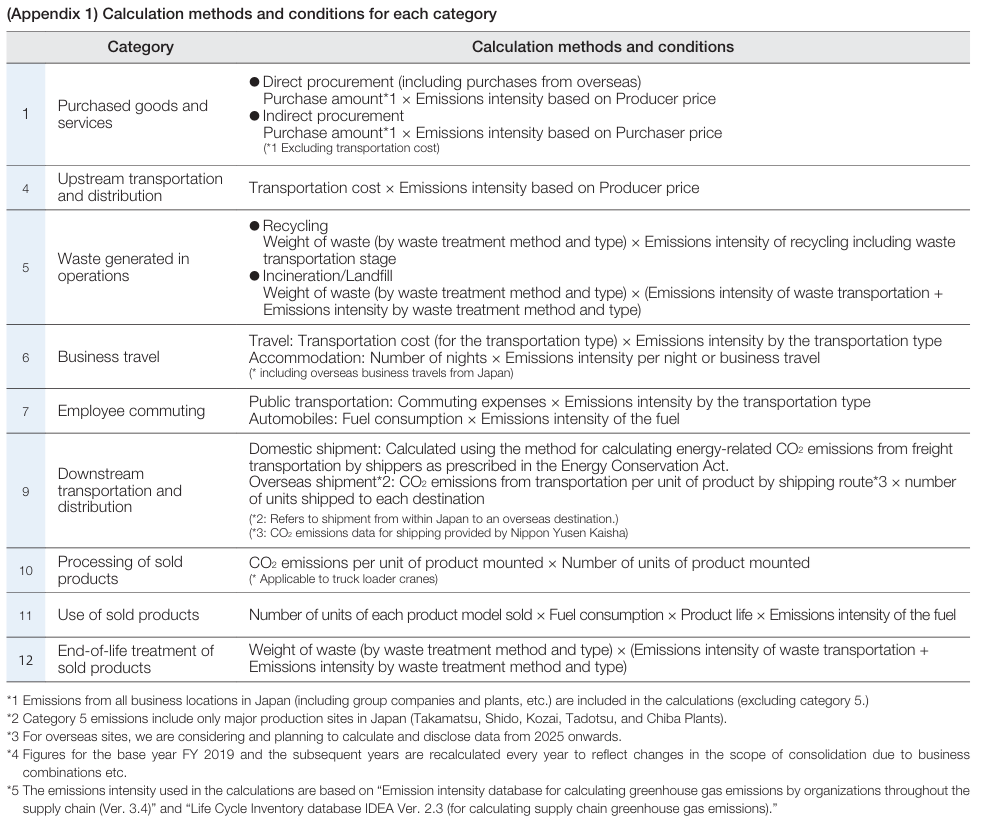
CO2 emissions from the Tadano Group (Scope 3) are shown as below.
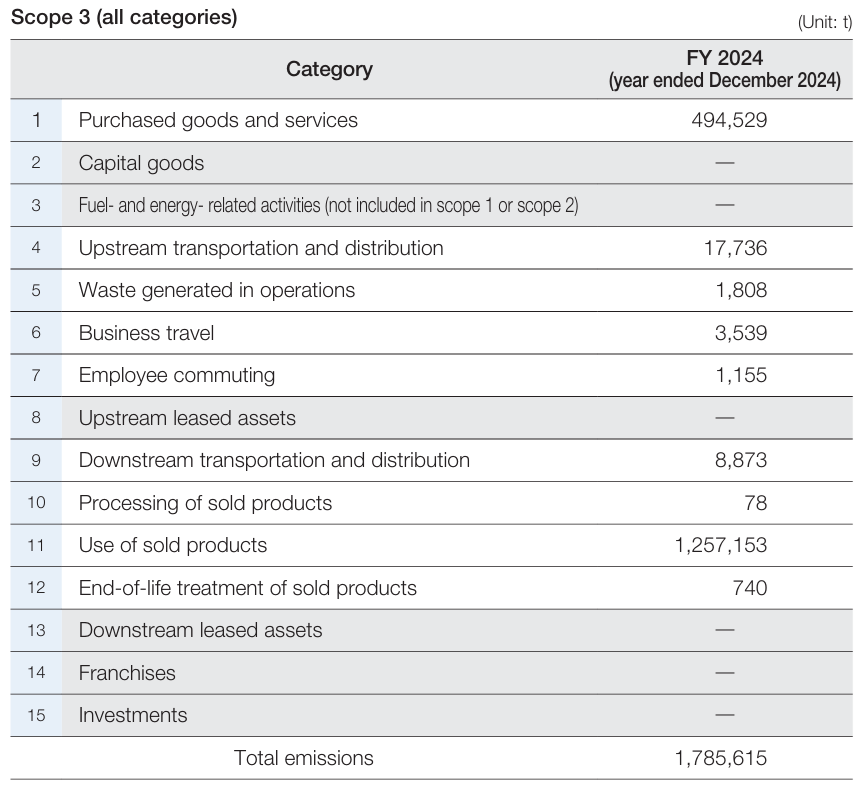
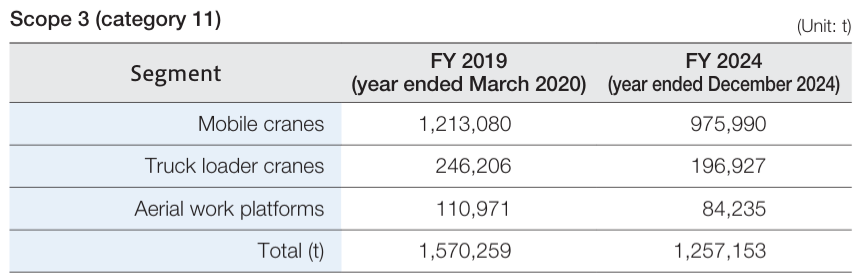
Finally, regarding reduction of CO2 emissions in Category 11 – use of sold products, which is one of the Tadano Group’s long-term environmental targets, the figures for FY 2019 (base year) and FY 2024 are as follows.
Future Actions
We will continue to discuss actions against climate change and work on them under the leadership of the Environment Committee across the entire group. We will continue to study for the following and disclose more information upon becoming available.
- Expansion of the scope of calculation of “scope 3 CO2 emissions” overseas
- Propelling climate change action in the supply chain
- Quantitative disclosure of a scenario analysis and setting and disclosure of materiality
Sustainability
Under our Corporate Philosophy of “Creation, Contribution, and Cooperation,” the Tadano Group strives to contribute to the preservation of the environment and the realization of a sustainable society through maximizing value to our stakeholders and engaging in sustainable business activities. We aim to pursue further excellence for the world and the future.
The Mid Term Management Plan (24-26) formulated in 2024 sets “Advancing decarbonization” as one of the basic strategies, and identifies addressing sustainability issues and management in consideration of capital cost and stock price as initiatives for sustainable growth.