

Governance
Our Basic Policy
The company places corporate governance as one of the important management issues in order to ensure transparency, soundness, and efficiency of our management. For corporate governance to function effectively, we believe we need to foster a sound corporate culture based on our corporate philosophy and develop a mechanism in which corporate management (and managers) are governed by such a culture. Equally important is to ensure that auditing is conducted properly by improving the auditing environment and expanding the role of the audit and supervisory board members.
To realize sustainable growth and a mid- to long-term enhancement of corporate value, we have established the Corporate Governance Guidelines, which set forth the Tadano Group’s basic approach to corporate governance.
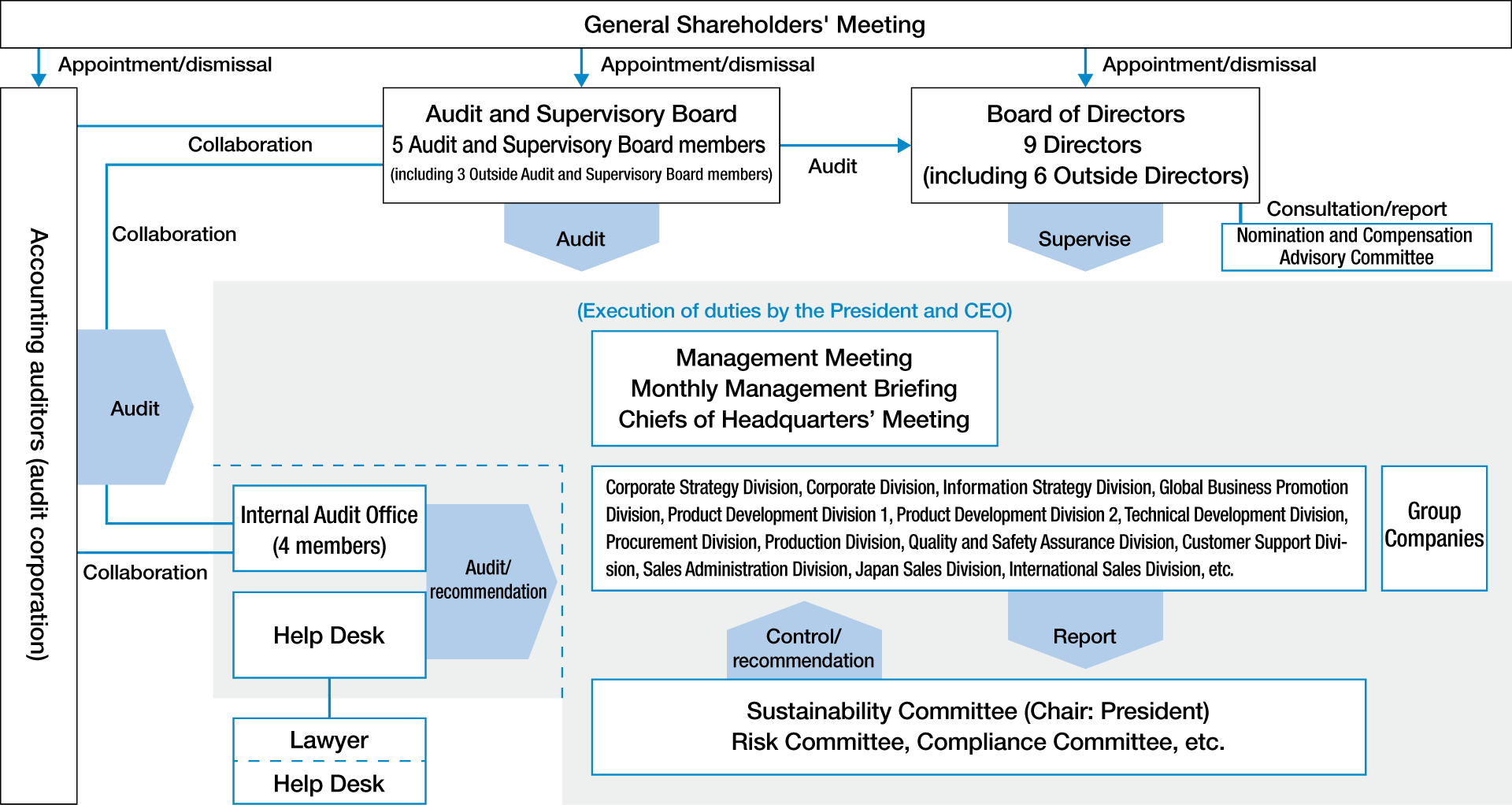
Corporate Governance Structure Chart
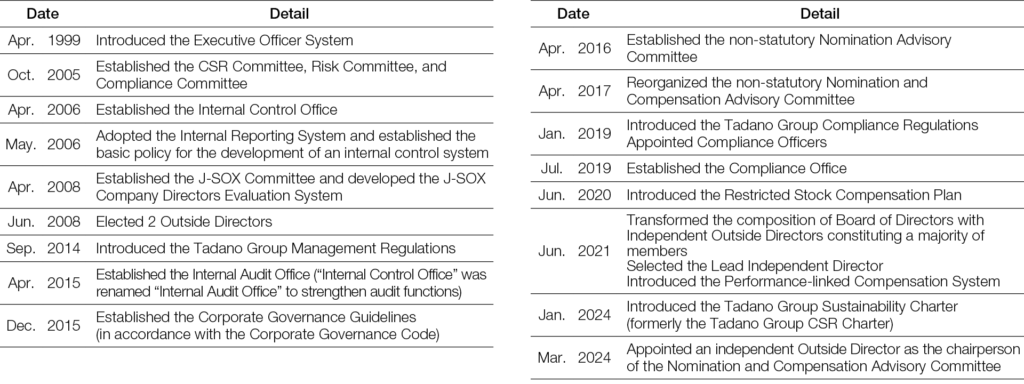
Changes in Corporate Governance Structure
Description of Meeting Bodies and Committees
Board of Directors
Comprised of nine directors, including six outside directors, Tadano’s Board of Directors develops and executes management plans and strategies with the goal of maximizing the company’s corporate value and making improvements such as in earning capabilities and asset efficiency. The board also establishes an internal control system and a risk management system to support appropriate risks taken by directors as a part of management decisions, thereby properly fulfilling its role and responsibilities.
Audit and Supervisory Board
Composed of five audit and supervisory board members including three outside audit and supervisory board members, the Audit and Supervisory Board maintains a system which allows audit and supervisory board members to audit business execution of directors by exercising their authority and appropriate judgment from an objective perspective based on the high level of expertise and information held by each audit and supervisory board member.
Monthly Management Briefing/Management Meeting
The Monthly Management Briefing (members: directors, executive officers, audit and supervisory board members, senior technologists and senior administrators) is held to report on business activities and to share information, while the Management Meeting (members: president, and managing executive officers and above, etc.) is convened to discuss management strategies. These advisory committee meetings are held in general once a month to assist the president’s decision-making.
Nomination and Compensation Advisory Committee
This Committee is chaired by an outside officer and comprised of eight members: two internal directors, five outside directors, and one outside audit and supervisory board member. Serving as an advisory body for the Board of Directors, the Committee discusses the nomination of directors and audit and supervisory board members and the appointment of executive officers, as well as decisions concerning remuneration for directors and succession plans, and reports the details of the discussion to the Board of Directors with the goal of ensuring fairness and transparency. In addition, as an advisory body for the president and CEO, the Committee discusses and reports to the president and CEO decisions concerning remuneration for executive officers with the goal of ensuring fairness and transparency.
Risk Committee
The Risk Committee promotes and supervises the management of Tadano Group’s business risks. The goal of the Risk Committee is to enhance the company’s risk management capabilities. Comprised of the chair designated by the president and members representing each division at the general manager level or above, the Committee meets biannually to identify and evaluate internal risks, implement solutions by assigning each risk to a department, and to conduct reviews on the results..
Chiefs of Headquarters’ Meeting
The Chiefs of Headquarters’ Meeting (members: president, executive officers, senior technologists and senior administrators) is held as a rule twice a month to facilitate business execution by executive officers and to enhance collaboration among executive officers.
Evaluating the Effectiveness of the Board of Directors in FY2025
(1) Evaluation Method
Scope of Evaluation:
• All 9 Directors
• All 5 Audit & Supervisory Board Members
Method:
• Anonymous questionnaire (administered by an external third-party organization)
※When designing the questionnaire, opinions from all participants were incorporated to ensure the content was effective and aligned with the current situation.
Evaluation Process:
• December 2025: Review and discussion of questionnaire items by participants
• January 2026: Questionnaire distributed and collected
• March 2026: Results of the Board of Directors effectiveness evaluation reported at the Board meeting, followed by discussion
Major Evaluation Items:
- Role and Functioning of the Board of Directors
- Composition of the Board of Directors
- Operation of the Board of Directors
- Management Strategy and Management Plan
- Internal Control and Risk Management
- Nomination and Compensation
- Performance of Outside Directors
- Training
- Dialogue with Shareholders
- Evaluation of Committees
- Overall Summary
(2) Evaluation Results
The Board of Directors confirmed that the Company’s governance framework—including its composition, roles, and operation—is appropriate, and that the Outside Directors contribute effectively to the quality and effectiveness of discussions at the Board and related forums.
Based on these findings, the Company has determined that the effectiveness of its Board of Directors is sufficiently ensured.
(3) Status of Responses to Issues Identified in the Previous Fiscal Year
For the issues identified in the FY2024 effectiveness evaluation, annual action plans were developed and measures were implemented through the Nomination and Compensation Advisory Committee as well as off-site meetings.
Issues addressed:
• Discussion related to diversity among Directors
• Discussion on the Mid-Term Management Plan and succession planning
• Response to sustainability and risk management
Outside Directors and Outside Audit & Supervisory Board Members with diverse expertise actively offered new perspectives and proposals, thereby deepening discussions. The Company will continue these efforts as part of continuous improvement in the next fiscal year.
(4) Issues for Further Improvement in Effectiveness Going Forward
The Company recognizes that the issues addressed in FY2025 require ongoing efforts.
In addition, the following themes will be incorporated into the annual action plan for further enhancement:
• Management that emphasizes cost of capital and share price
• Discussion on human capital strategy and talent development
• Enhancing focused discussions on matters with high importance and urgency
Compliance Initiatives
Compliance assurance system
In keeping with the Tadano Group CSR Charter and the Tadano Group Compliance Regulations, all employees of the Tadano Group engage in transparent, sound, and honest business activities in compliance with relevant laws and regulations and social norms, as well as high ethical standards.
To promote compliance, the Chief Compliance Officer designated by the president takes charge of the overall compliance system of the Tadano Group and supervises compliance policies. The Compliance Officer appointed by each group company takes charge of matters concerning each company’s compliance system. We also have the Compliance Committee, consisting of members representing each division of Tadano at the general manager level or above..
Compliance Committee
The Compliance Committee meets twice a year, shares and discusses compliance issues, and makes reports on the activities of group companies. The Committee also raises awareness of compliance through education and trainings on regulatory compliance using educational tools and other materials, and strengthens the compliance system by providing assistance such as for implementation of regulatory compliance measures..
Tadano Group Compliance Regulations
The Tadano Group Compliance Regulations were established in January 2019 to ensure that all officers and employees of the Tadano Group continuously engage in proper compliance practices (meaning compliance not only with laws and regulations, but also rules of international community, internal rules, and corporate ethics). The regulations set forth the codes of conduct for 18 items, including anti-bribery and corruption, labor rights, and proper accounting and tax return filing, as well as compliance education and auditing.
 Tadano Group Compliance Regulations(Excerpt from the Codes of Conduct only)
 Promoting compliance
Employees are given a copy of the Compliance Book, which describes compliance issues encountered in daily operations, and read through it line by line whenever appropriate during gatherings held at each workplace, such as morning meetings. Compliance seminars are held for employees periodically using e-learning, and group workshops are organized on specific themes when needed.
Internal reporting system
We have established an internal reporting system so that employees can report illegal and inappropriate actions to the company. We have set up an internal hotline as well as an external hotline (an outside law firm) to receive reports from whistleblowers.
Tadano’s internal regulations protect whistleblowers by ensuring their anonymity and prohibiting any unfair treatment of them. Violations of laws and regulations, if confirmed, are reported to the Compliance Committee. If the violation is deemed serious, the Committee immediately provides its opinions on countermeasures based on the results of investigation and reports the violation and the countermeasures to the president and audit and supervisory board members.
Country-by-Country Report (CbCR)
Sustainability
Under our Corporate Philosophy of “Creation, Contribution, and Cooperation,” the Tadano Group strives to contribute to the preservation of the environment and the realization of a sustainable society through maximizing value to our stakeholders and engaging in sustainable business activities. We aim to pursue further excellence for the world and the future.
The Mid Term Management Plan (24-26) formulated in 2024 sets “Advancing decarbonization” as one of the basic strategies, and identifies addressing sustainability issues and management in consideration of capital cost and stock price as initiatives for sustainable growth.